The Double End bag is a tricky little piece of boxing equipment that will help you hone your punching timing and hand-eye coordination. It can be a little frustrating in the beginning (the darn thing is hard to hit!!!), so stick with basic drills until you get a feel for it. Don't forget to always punch it with good technique - make sure you transfer your weight from foot to foot as you're punching and that your shoulders cross your centerline in your crosses and hooks. Do NOT sacrifice good body mechanics in order to hit the bag with arm punches! You may even loosen up the rubber bands a little so that it swings with a lower frequency (slower, that is) and tighten them up again as you get faster and more precise. That was my advice. Now here's Vagelis' program:
JKD Top & Bottom Bag Exercises Handbook
Always focus on hitting the (DE, Double End) bag AS IT COMES TO YOU! Don't hit it as it is going away. TRY TO SEE THE BAG AS IS RETURNS TO YOUR FACE. Also, within the same practice session, switch from light bag gloves, to heavier boxing gloves to bare fists; this changes the speed of the bag, and forces you to adjust your timing and rhythm. You tend to hit the bag with the same amount of force all the time and this makes it easier to pick up on the rhythm. Try to vary the force of your punches.
Drills:
*Basic Jab-work on seeing the ball
*Jab and Slip right and left
*Jab-catch-Jab-good ol' Panantukan drill works here (You can do a ton of the Panantukan drills on the DE ball)
*Jab-Cross-make sure to hit the ball as it returns
*Jab-Cross and slip-Depending on how hard you hit with the cross-you may or may not successfully slip.
*Jab/R or L uppercut
*J/C/R or L Uppercut
*Jab/Lead Hook-try to hit the ball as it returns
*J/Lead Hook/C-try to not "wait" on the ball-hit it accurately on its first return and first "lateral" motion in front of you as a result of you hook-easier said than done.
*Pak sao by capture-you can do two variations in your "boxing" section of DE ball work-1) put your "pak" hand on the ball and punch the air or 2) pak in the air and hit the ball
*Gunting the ball with either hand as it returns-this is great with a training knife too (don't use real blades as it is hard on the ball :)
Elbows and destructions in the same fashion as above.
*Add the head butt-(make sure you intentionally head butt the ball and don't call a missed slip a head butt! Also make sure the metal fixtures are covered in tape so you don't poke out your eyes!
*As the ball returns slip inside (this is where your imagination comes to play) and take a low single on the rope. This is where the small sandbag comes in handy. It needs to be heavy enough to hold the bag but light enough to grab and pick up.
*Sometimes after you take the single to the left, you drop the weight and shoot a double under the boxing bag which is hung with the bottom at waist height to the left of the DE ball.
*Shorten the cord (lengthening the elastic) so that the ball is about 2-3' off the ground, work your thrust kicking from the butt scoot position. Accuracy and timing is important here also.
*Hang the ball at waist height and work the knees, you can also punch the cord above the ball to screw up the rhythm and return.
*Use your feet to screw up the rhythm by thai kicking, pak tek, now tek, whatever tek the bottom rope.
*Shoulder roll the ball (you visualize going to the outside) and on the return beat: -Uppercut with the rear hand -Bob/weave to the other side and lead hook or uppercut. -Uppercut/overhand, overhand/uppercut, hook (just box)
*Jeet sao (stopping hand) the ball in flight with your palm-then combo
*Place a "dot" with tape on a couple sides of the ball and try to eye jab the dot as the ball is in flight-this really enhances your ability to see/-if the ball is spinning too fast (because you didn't hit it very square) this can be near impossible until it slows.
*Place the DE ball about 2 feet off a wall so when you hit it towards the wall it rebounds back at you hard and fast. This is a lot of fun for your defense. This is a solo version of a partner drill I do-each person stands on opposite sides of the ball and works it at the same time-this is a blast.
*Place your back foot on a wall so that the return of the ball will hit you and you can't move backward as you work the ball-this is fun also.
*Male Triangle Lead Drill: With the right hand, Jab, elbow, back fist, hook, step diagonal back with right foot, and left Jab, elbow, back fist, hook, step, etc.
*Ambidextrous Lead Drill: Jab, uppercut, hook, step back into right lead and cross with the left, uppercut with the left, overhand with the left; then jab, uppercut, hook with the right hand, step back into left lead, cross with the right, upper with the right and overhand with the right etc. Always adjust your distance to the bag appropriately and work in slipping right and left if you need to b/c of your proximity to the bag.
MAKE SURE YOU CIRCLE THE BAG-DON'T STAND IN ONE PLACE.
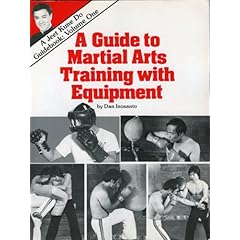
For more info on JKD equipmnet training you can check out this classic book by Guro Dan Inosanto, although I believe it's now out of print:
Guide to Martial Arts Training With Equipment
Always make sure you enjoy your training,
Spyro Katsigiannis
Systema Russian Martial Art & Filipino Kali instructor, San Shou coach.

Visit My eBay Store: Fighter's Zone


